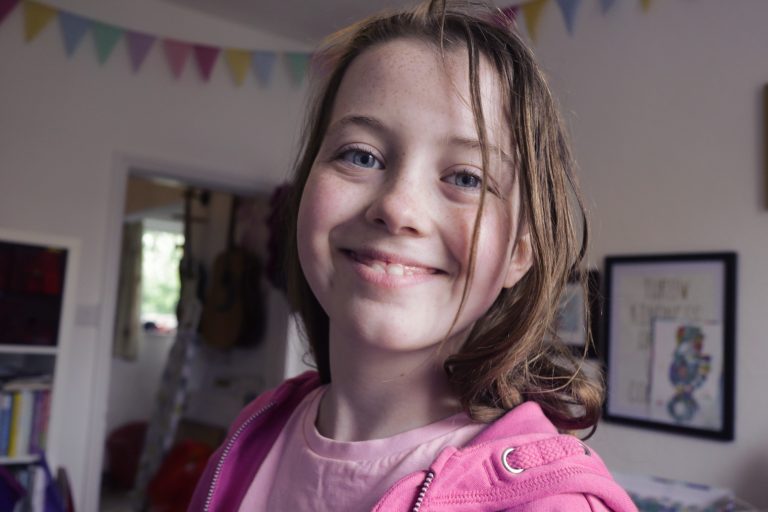
My daughter blinked in roughly 70% of photos taken at her seventh birthday party. I know this because I sat and went through all of them afterwards, which is a very specific kind of misery. We had the decorations, the cake, the light was actually decent, and she looked like she was receiving bad news in nearly every shot.
I was shooting on a Pixel 8 Pro at the time. And here’s the thing: it didn’t matter, because Best Take fixed most of it.
That’s probably the fastest way to summarise the difference between Google Pixel and iPhone when you’re using them primarily to photograph children. Pixel has a trick up its sleeve that parents specifically will feel immediately. Best Take shoots a short burst and then lets you swap individual faces between frames — so if your kid has their eyes open in frame 3 but is pulling a face in frame 7, you can combine them. It sounds gimmicky until you actually use it. Then it sounds like the only reasonable way to photograph a six-year-old.
iPhone doesn’t have an equivalent. Apple’s approach to burst shooting is more traditional: shoot fast, pick the best one, accept that someone always blinked.
That said, it’s not a clean Pixel win across the board. A few things are worth being honest about.
iPhone’s Action Mode, introduced a few years back and refined since — is genuinely excellent for fast-moving subjects. If your kids play sport, ride bikes, or just sprint around in ways that make focusing a genuine challenge, the stabilisation and motion handling in Action Mode is hard to argue with. Pixel handles movement well, but iPhone’s video in particular is still the benchmark most people reach for. I shoot more stills than video, so this matters less to me personally. If you’re the parent who primarily films things rather than photographs them, that changes the calculation.
The other honest point: iPhone’s processing is more predictable. What you see in the viewfinder is broadly what you get. Pixel’s computational photography is doing more behind the scenes, which usually works in your favour but occasionally produces a result that looks slightly over-processed, smoothed in ways you didn’t ask for, or with a background that’s been selectively sharpened in a way that reads as slightly uncanny if you look closely. It doesn’t happen often. When it does happen, you’ll notice it. People with a photography background tend to notice it more than casual shooters.
Skin tones are worth mentioning. Pixel’s Real Tone processing has been noticeably better for a couple of generations now at handling a range of skin tones without washing things out or adding orange. iPhone has improved here too, but on mixed-group shots, kids at a party, school events, that kind of thing — Pixel still edges it for me.
Low light is probably where the gap feels biggest day-to-day. Indoor kids’ birthday parties, late-afternoon play sessions where the light has dropped, school halls. Night Sight on Pixel isn’t quite the party trick it was when it launched; everyone has caught up, but Pixel still handles the combination of low light and fast-moving subjects better than iPhone does. A child who won’t stay still in a dim room is basically a worst-case scenario for any smartphone camera. Pixel copes with it more gracefully.
So which one?
If you’re a parent first and a photographer somewhere after that, and you’re trying to capture kids rather than landscapes or products: get the Pixel. Best Take alone will save you hundreds of unusable shots over the course of a year. Add the low-light handling and the skin tone processing and it’s a clear answer for that specific use case.
If you shoot more video than stills, or your household is already deep in the Apple ecosystem and the friction of switching matters, or you’re photographing a lot of fast outdoor action, then iPhone is a genuine contender and you won’t be making a mistake.
The birthday party photos turned out fine, for what it’s worth. My daughter had her eyes open in nearly all of them. Thanks to a phone doing quiet, invisible work that I would have had to do manually ten years ago with a camera that cost fifteen times as much.
She still pulled a face in most of them. That one I can’t fix.
About The Author